
Where the dead find a place
A cemetery connects three tasks: burying the dead, making room for grief and maintaining a place over time. Its form reflects how a society organises those tasks.
- Period
- Across the eras
- Place & context
- Changing European contexts; regional differences must be stated in each case.
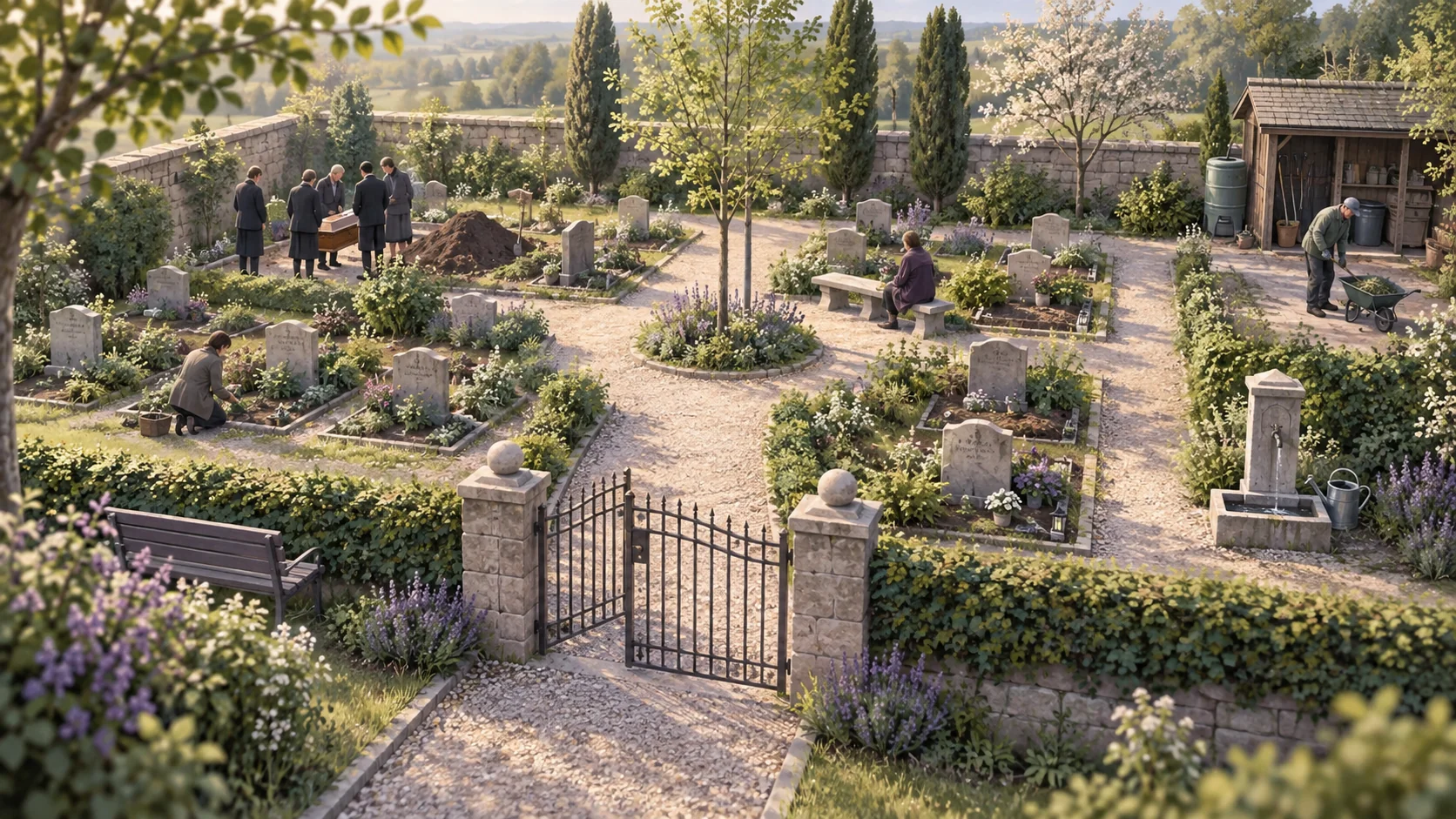
A grave and a cemetery operate at different scales
A grave is an individual burial place. A cemetery brings many such places into a permanently organised site. Paths, entrances, rules and maintenance turn a collection of graves into a shared institution. Our comparison therefore considers operation as well as grave markers.
Location shapes the relationship with the dead
A churchyard, an urban outskirts cemetery and a rural burial place involve different everyday journeys. A nearby place may make regular visits easier; an extensive site needs orientation. Distance is therefore part of the question of who can actually reach a place of remembrance.
Ohlsdorf combines burial and landscape
Hamburg's Ohlsdorf cemetery opened in 1877 and was designed as a landscape garden. The example shows that planning a burial place also involves a decision about how the living spend time there.
Evidence: [1]
Three terms, three perspectives
A park cemetery primarily describes design, a central cemetery an urban function, and a village cemetery its local setting. These qualities can coexist. Separating them allows a more precise description: what does the place look like, whom does it serve and who keeps it accessible?
A question to carry with you
Whose lives and memories does a place make visible?
Sources & further reading
As of
Questions about this topic
Is cemetery history the same everywhere?
No. A detailed account must identify its time, place and social context.
Why does cemetery design belong to cultural history?
Places of farewell and remembrance reflect needs, belonging and collective decisions.