
Park cemeteries: landscape and remembrance
A park cemetery makes the journey to the grave part of remembrance. Landscape, orientation and care form a shared task.
- Period
- Since the nineteenth century · Ohlsdorf
- Place & context
- Hamburg; a local example of landscape design.
Ohlsdorf has several design layers
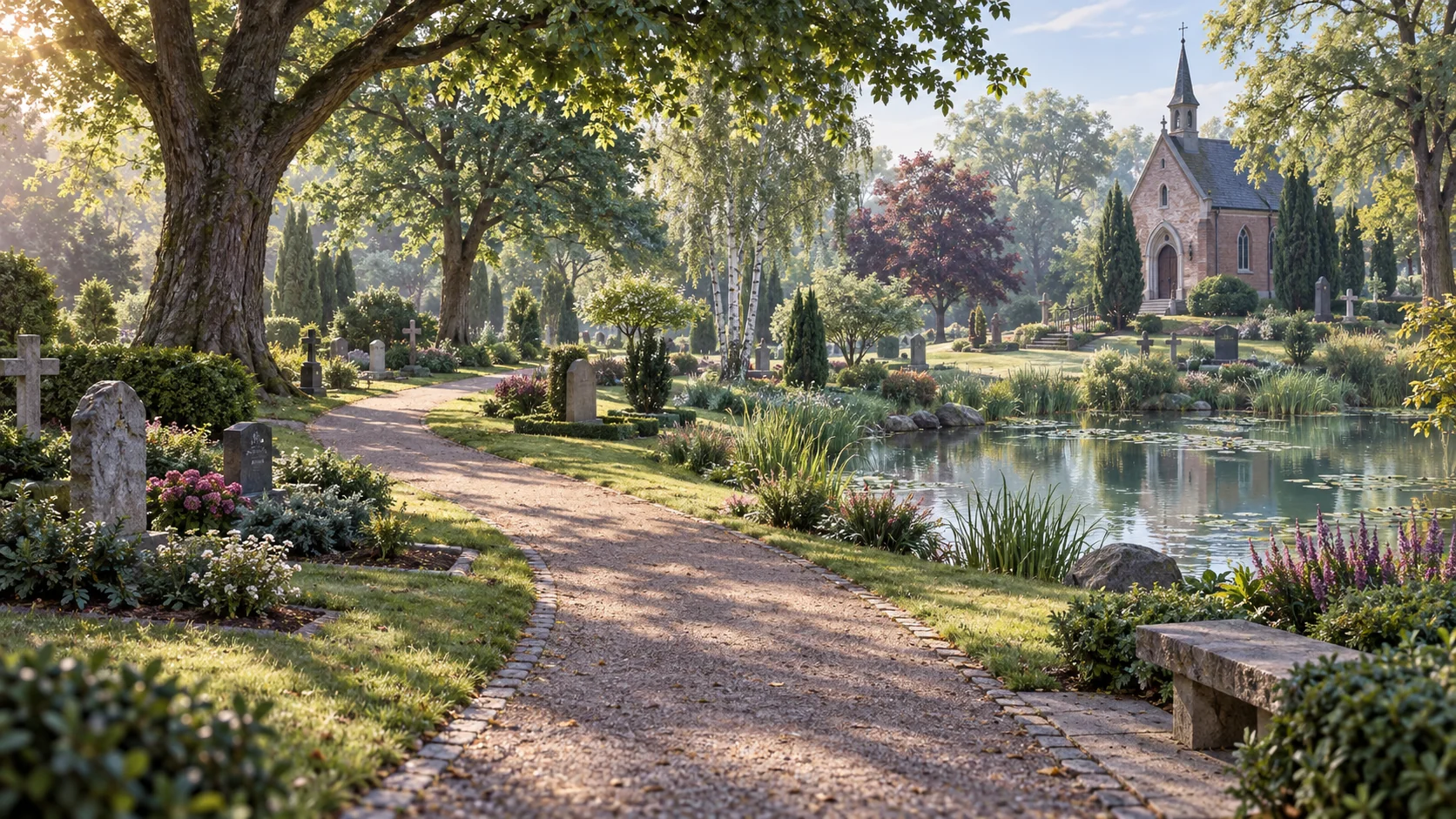
At Ohlsdorf, Wilhelm Cordes developed landscape-garden design from 1877; Otto Linne added more geometric areas from 1919. Hamburg describes different designs within one cemetery. ‘Park cemetery’ does not mean the same path layout everywhere.
Evidence: [1]
A visit begins before the grave
Trees, junctions and open views influence movement through the grounds. Quiet is not created at the plot alone. A broad landscape may invite lingering but needs clear orientation so that a personal place of remembrance can be found.
Garden design needs continuing labour
A designed landscape is not maintenance-free. Paths need to remain usable, trees tended and graves accessible. Our editorial conclusion puts responsibility and funding alongside aesthetics: design works only while its use is supported.
Considering remembrance and new uses together
Where less space is needed for new graves, links to existing burial places still matter. The 2050 chapter explores adaptation as a conditional scenario. The central question is how unused land can remain an understandable and reachable place.
A question to carry with you
How does a path affect what we notice and remember?
Sources & further reading
As of
Questions about this topic
Are park and central cemeteries opposites?
No. Park cemetery primarily describes design; central cemetery describes an urban function. Both can coincide.
Why is Ohlsdorf not a model for every cemetery?
Its creation and development are local. Other places offer different design solutions.