
Cemeteries in transition: a horizon to 2050
Smaller burial plots do not automatically make a large cemetery easier to operate. By 2050, the central task could be planning interment, care and new uses together.
- Period
- To 2050 · conditional scenario
- Place & context
- Ohlsdorf as an evidenced starting point, not a forecast for all cemeteries.
The planning question already exists
Ohlsdorf 2050 responds to changing burial forms and declining occupancy. Hamburg examines new uses for parts of the grounds and the cemetery's long-term future. The starting point is a specific project, not a forecast for every cemetery.
Evidence: [1]
Why fewer graves do not simply mean savings
In our planning assumption, paths, trees and buildings still need care where no new plots are allocated. If occupancy declines, operation and funding need to be reconsidered together. An unused area is initially a responsibility; its value depends on continued access and maintenance.
One possible path: connected areas of care
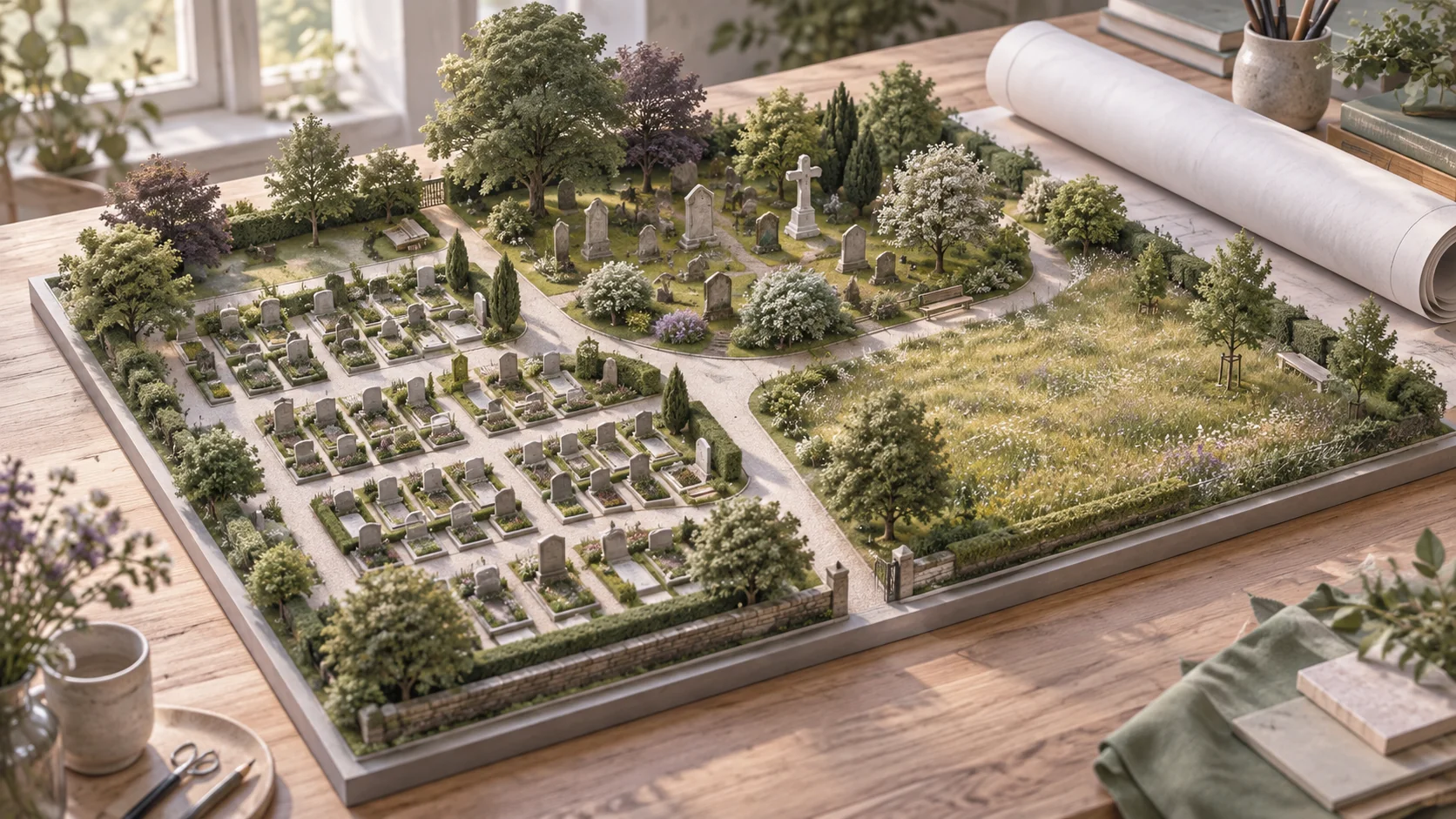
If new burials concentrate in accessible areas while existing rights remain respected, other sections could be maintained more as natural and memorial spaces. Clear routes, understandable signs and reliable funding would be needed. This would be a deliberate decision, not an automatic result of cremation.
Another possibility: fragmented adaptation
If individual areas are abandoned without considering operation and visitor routes, confusing intermediate spaces could emerge. The scenario compares two ways of organising similar conditions. A particular cemetery's actual path must be assessed through its local plans.
A question to carry with you
Which change preserves a place rather than losing it?
This scenario draws questions from evidence. It does not assert a future outcome.
Sources & further reading
As of
Questions about this topic
Is the 2050 outcome certain?
No. Today's planning question is evidenced; the implication is conditional.
Does Ohlsdorf 2050 apply nationally?
No. Other cemeteries have different conditions.