
Cemeteries in a changing climate
A place of remembrance needs to remain reachable when heat, drought or heavy rain make visits harder. The 2100 horizon makes adaptation a question of participation.
- Period
- To 2100 · conditional scenario
- Place & context
- Europe; climate risks vary by place.
The climate evidence behind the question
The IPCC identifies heat, water scarcity and flooding risks for Europe. Their extent depends on warming, location and adaptation. This establishes neither uniform weather in 2100 nor a cemetery plan designed by the IPCC.
Evidence: [1]
How this becomes a cemetery question
Our application starts with a visit: a hot, unshaded path could be difficult for a frail person. Drought could require additional care; heavy rain could interrupt routes. The relationship concerns the ability to reach a grave safely, as well as plants.
One possible path: adaptation before failure
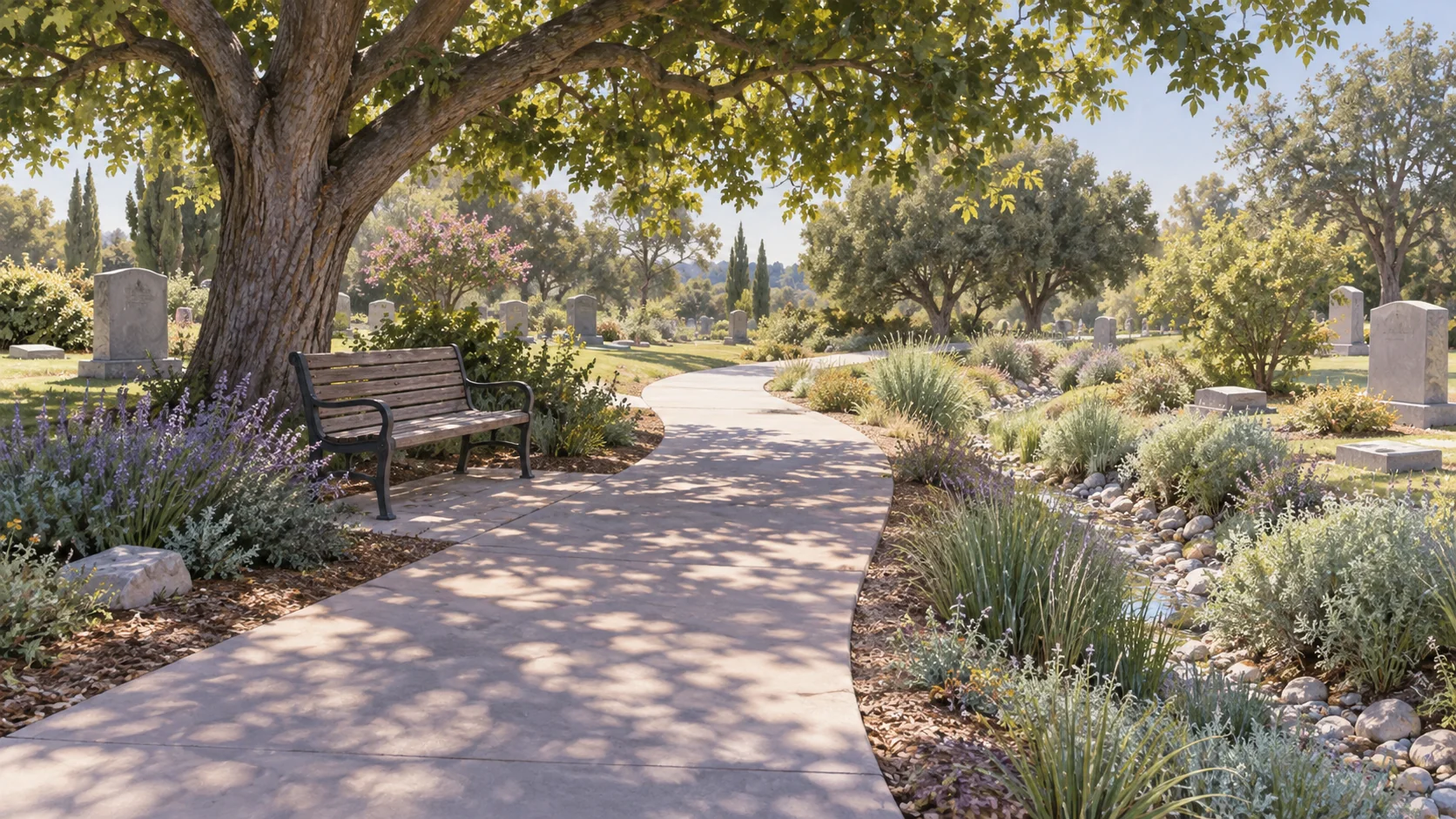
Where local risks are assessed and care funded over time, shade, suitable planting and rainwater management could be planned together. Grave use and heritage protection would need attention. Appropriate measures would depend on soil, existing features and regional information.
Another possibility: repeated repairs
If changes occur only after damage, some paths or areas could become temporarily inaccessible. Lower water use alone would not automatically improve visiting conditions. The decisive factor is the capacity to adapt in advance, rather than a particular calendar year.
A question to carry with you
How can memory remain accessible as its environment changes?
This scenario draws questions from evidence. It does not assert a future outcome.
Sources & further reading
As of
Questions about this topic
Does the IPCC predict a cemetery design?
No. Design is discussed here as a possible implication of general climate risks.
Must all cemeteries use the same plants?
No. Climate, soil, location, use and protection needs differ.