
What can remain after a thousand years?
A stone may survive a thousand years while its name becomes unreadable. A copied file may remain while its context is lost. Persistence and remembrance are different things.
- Period
- 3026 · beyond robust social forecasts
- Place & context
- No asserted future state, habitat or technology.
Preserved does not mean understood
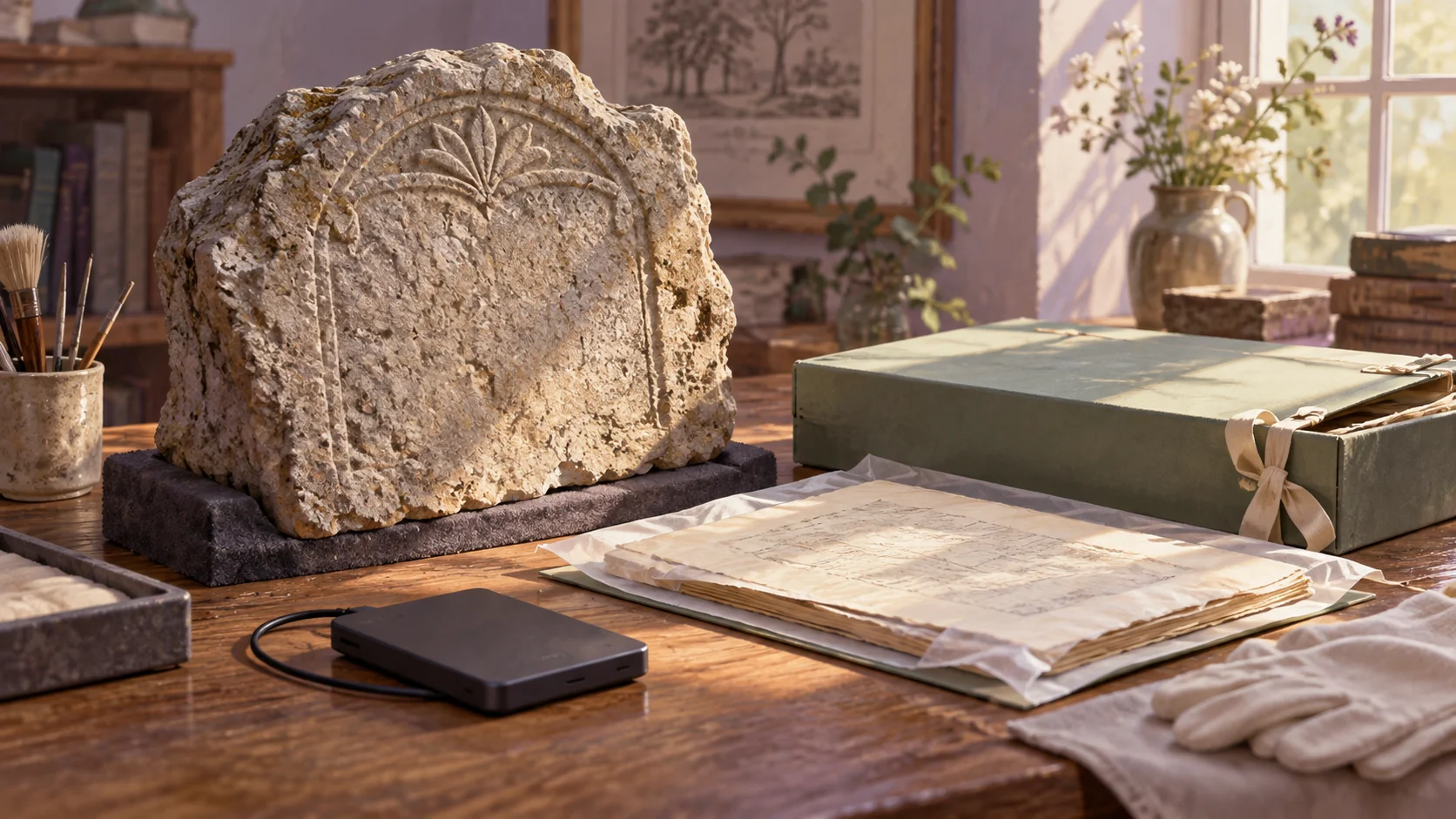
For 3026 we distinguish three requirements: evidence must survive, remain readable and be interpretable. A marker without a name preserves a form; a name without context preserves a piece of information. Both are traces, not a complete memory of a person.
Digital records also need transmission
The UNESCO charter of 2003 identifies obsolete hardware and software and unclear preservation responsibility as risks to digital heritage. Storage does not remove the task of care. It shifts that task to formats, access and responsible people or institutions.
Evidence: [1]
Two imagined paths of transmission
If names, locations and explanatory records remain connected, later people might interpret a burial place more readily. If the connection breaks, the same place might appear as an enigmatic monument. Neither possibility assumes a particular technology or society in 3026.
What the distant horizon changes today
The thought experiment suggests a present task: record context and responsibility, rather than simply storing as much as possible. We cannot decide what later generations will value. We can avoid making records difficult to understand through missing connections today.
A question to carry with you
What do we leave beyond a name?
This scenario draws questions from evidence. It does not assert a future outcome.
Sources & further reading
As of
Questions about this topic
Is there a robust funerary forecast for 3026?
The sources used here provide none. This page poses conditional questions only.
Is a stored name the same as preserved memory?
No. Readability, context and access are also required.