
Central cemeteries: a city organises farewell
A central cemetery brings a city's burial services together. Its scale answers a service need while creating requirements for routes, orientation and personal remembrance.
- Period
- Nineteenth and early twentieth centuries
- Place & context
- Nuremberg as a local example.
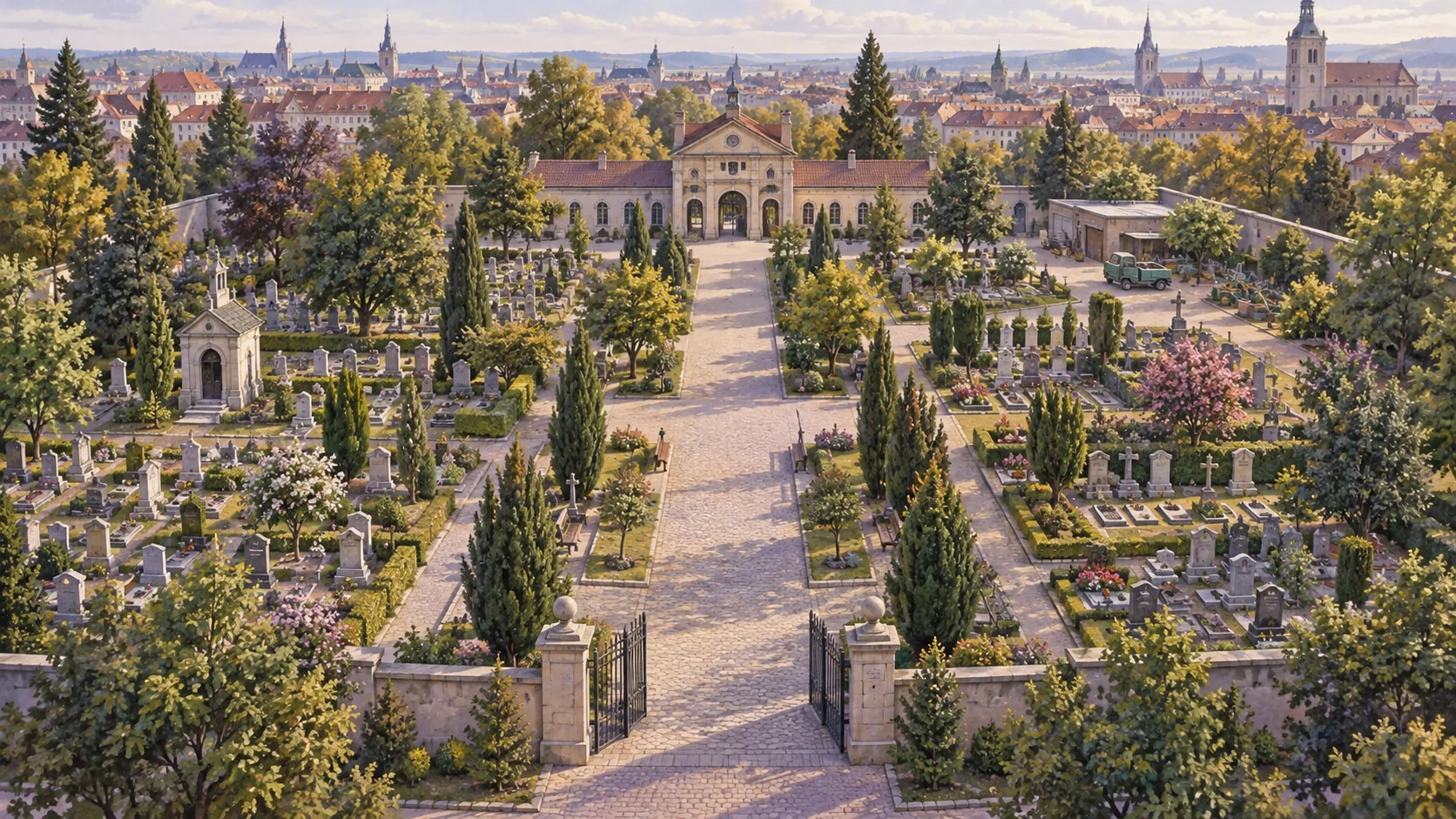
Nuremberg establishes shared infrastructure
Nuremberg's Westfriedhof was inaugurated as the ‘Centralfriedhof’ on 25 July 1880. The name indicates an urban function: one large shared place was intended to accommodate a growing city's burial needs.
Evidence: [1]
Concentration changes the process
A shared site can bring spaces, routes and operational tasks together. Relatives encounter a different setting from a small local burial ground. Our comparison considers organisational capacity and individual accessibility together.
Large does not necessarily mean anonymous
Extensive grounds can contain personal graves and clearly named communal areas. Conversely, small grounds do not guarantee close personal connections. Identification, visiting opportunities and space for individual remembrance within shared operation are decisive.
Function is not a garden style
‘Central cemetery’ prescribes neither straight nor winding paths. A central cemetery can also have park design. ‘Village cemetery’ instead describes a local setting. This distinction prevents size, appearance and ownership from being confused.
A question to carry with you
What does a city gain from a shared place — and what becomes more distant?
Sources & further reading
As of
Questions about this topic
Is every large cemetery a central cemetery?
No. The name depends on function and local history, not area alone.
How does this differ from the park cemetery page?
Here urban organisation is central; there landscape design is central. The aspects can overlap.