
Farewell moves beyond the city
In Nuremberg in 1518, concern about plague becomes a lasting reorganisation of burial. New places for the dead also change the journeys of the living.
- Period
- 1518
- Place & context
- The imperial city of Nuremberg; not a simultaneous change in every city.
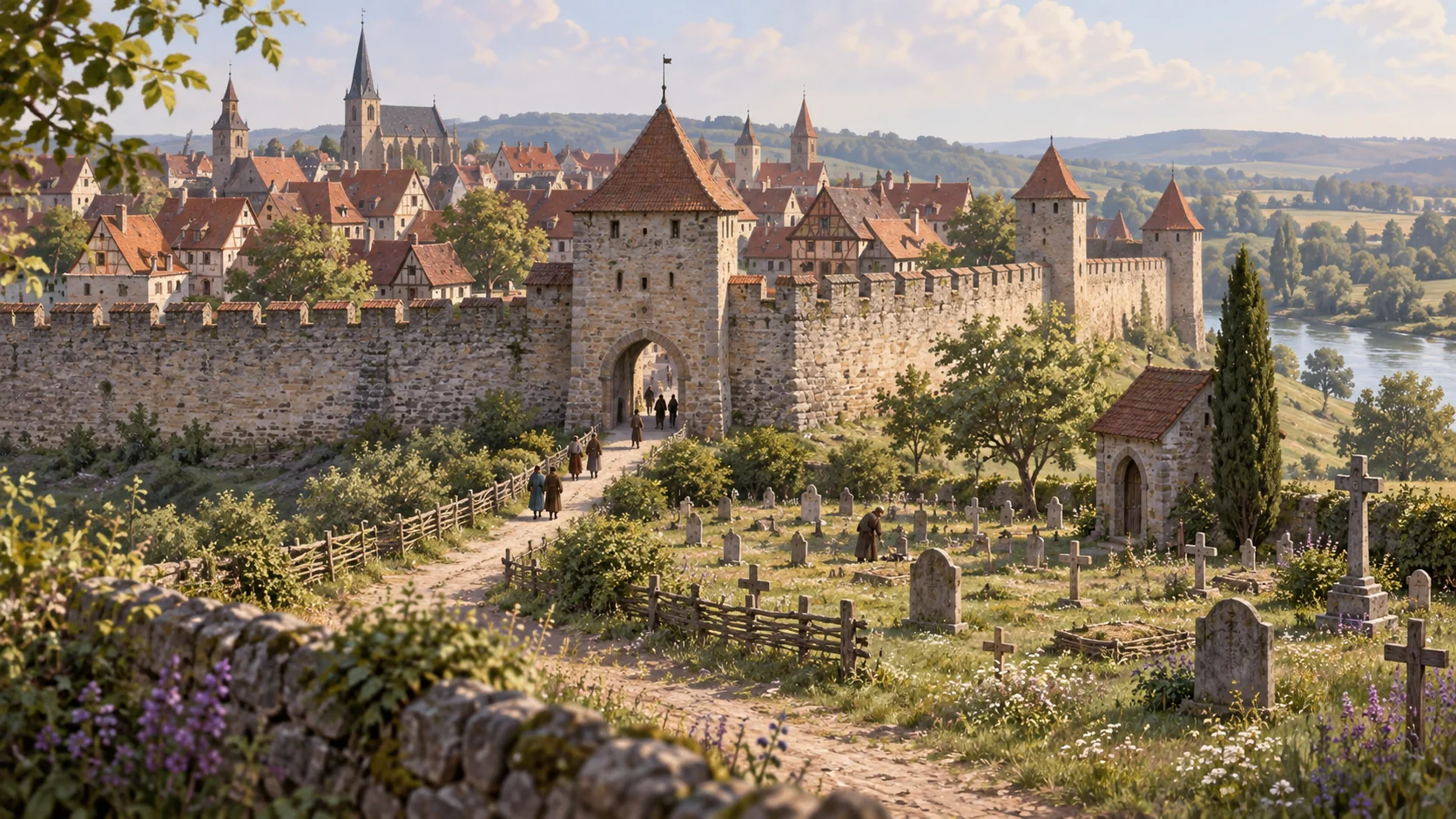
Plague prompts a decision
From 1518, Nuremberg's council allowed burials inside the walls only exceptionally. The city archive identifies plague as the reason. The measure developed into a broader organisation of urban burial.
Evidence: [1]
The city allocates new routes
The existing Johannis cemetery was expanded for the Sebald side, while the Rochus cemetery served the Lorenz side. The change involved more than distance: the city also assigned its population to burial places outside the walls.
Evidence: [1]
A new location changes everyday life
Anyone wishing to visit a grave must travel to it. Relocation can separate burial space from everyday surroundings and reorganise visits. This is a spatial inference; individual families' experiences would require further personal or local sources.
Why this transition matters
The location of the dead appears here as the result of urban decisions. Large shared grounds and technical facilities emerge later in the nineteenth century. The journey follows changing responsibilities and infrastructure, rather than a simple retreat from religion.
A question to carry with you
How far from daily life should a place of remembrance be?
Sources & further reading
As of
Questions about this topic
Were cemeteries moved everywhere in 1518?
No. This date belongs to a reorganisation in Nuremberg rather than a universal boundary.
Which places gained importance in Nuremberg?
The Johannis and Rochus cemeteries outside the city walls became important burial places.