
Burial in the eighteenth century
Vienna reorganised its burial grounds in 1784. This example connects ideas about health, urban decisions and the routes people take to remember.
- Period
- Eighteenth century · Vienna 1784
- Place & context
- Vienna under Joseph II; a regional example, not a Europe-wide development.
1784: a boundary changes burial places
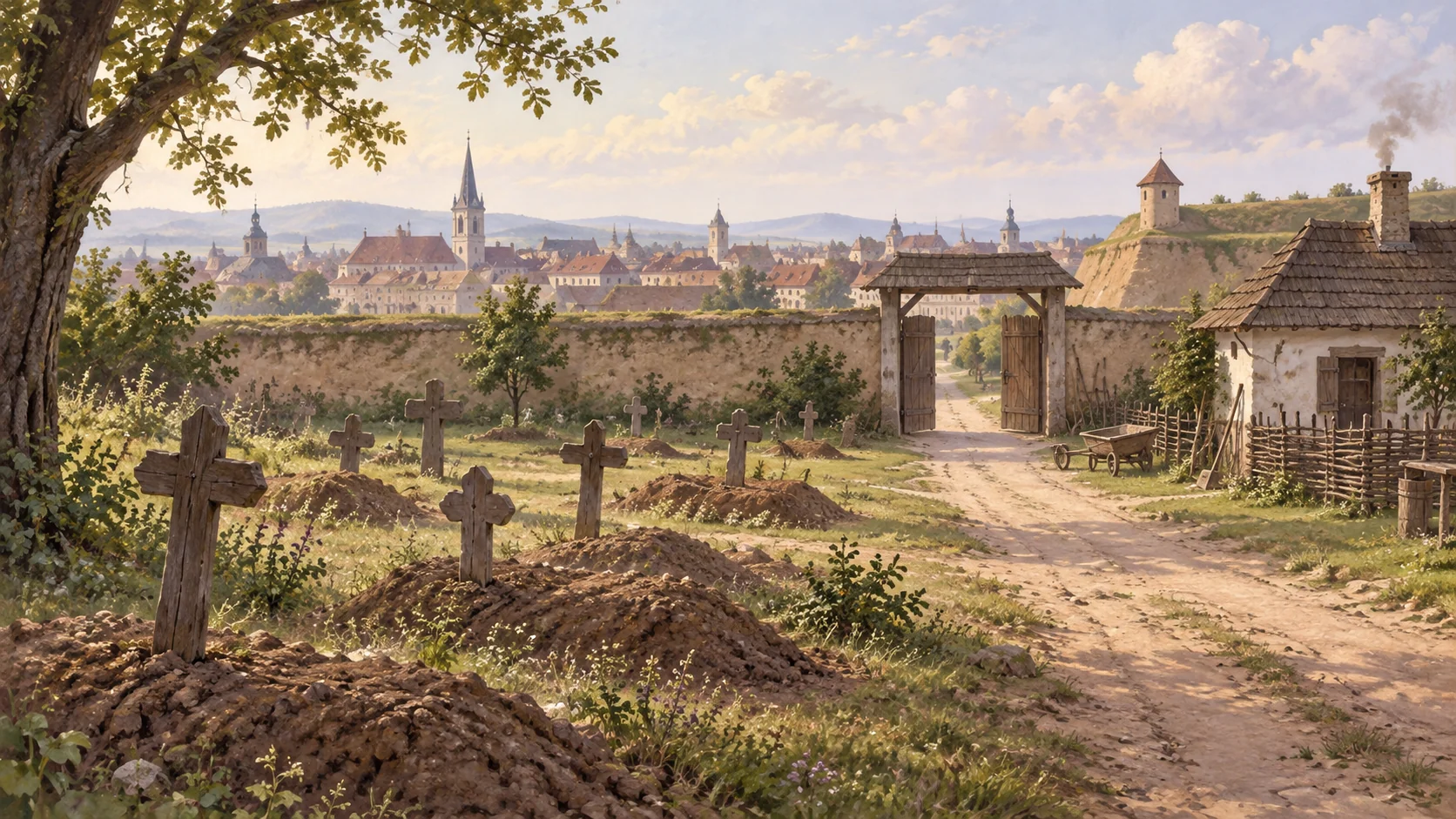
Joseph II ordered the closure of cemeteries inside Vienna’s Linienwall, to be replaced by burial grounds outside it. Vienna’s city archive identifies fears of harmful emanations as part of the context.
Evidence: [1]
Understanding health in its own time
The explanation through miasmas belongs to historical thinking and should not be equated with modern medical knowledge. Our interpretation concerns how ideas about health influenced decisions about burial locations.
Evidence: [1]
St Marx as a local trace
Vienna dates St Marx’s use as a burial ground to 1784–1874. The surviving site connects the late eighteenth and nineteenth centuries. Its present monuments do not show the founding year unchanged.
Evidence: [2]
Questions that remain open
This Viennese case explains neither every eighteenth-century funeral nor individual families’ experiences. Differences of place, religion and social position require their own sources. Further questions concern funeral processions, access, grave design and responsibilities.
A question to carry with you
Who decides how far a burial place may be from the life of a city?
Sources & further reading
As of
Questions about this topic
Did Vienna’s reorganisation apply everywhere?
No. This chapter concerns Vienna in 1784; other cities and regions followed their own developments.
Does the illustration reconstruct St Marx in 1784?
No. It is a generic concept image of a burial ground outside a city, not a historical reconstruction.