
When people settle
People who cultivate fields and remain in one place must also find space for their dead. Settlement history and burial history can therefore be read together.
- Period
- c. 5500–3000 BCE
- Place & context
- Central Germany as one regional example; other regions follow different chronologies.
A place acquires permanence
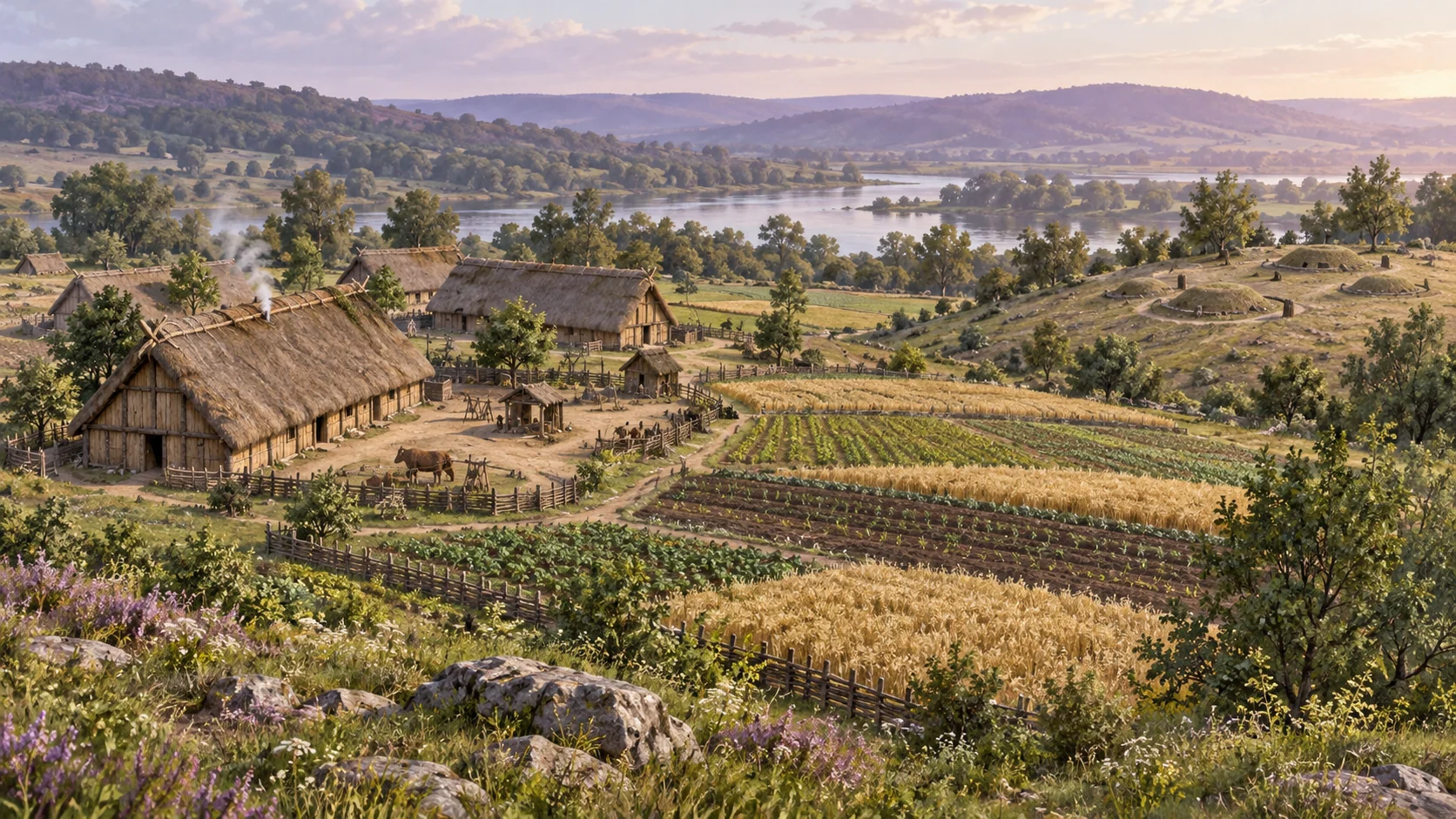
Farming and livestock keeping change the relationship with land: fields, houses and stores tie labour to particular places. The Halle museum dates this change in central Germany to about 7,500–7,000 years ago. The place of the dead now belongs within a landscape of lasting living spaces.
Evidence: [1]
Salzmünde shows more than an orderly cemetery
The Neolithic enclosure at Salzmünde contained, among other finds, reburied bodies and burials beneath layers of pottery fragments. The evidence challenges the idea that settled life produced one uniform burial practice everywhere.
Evidence: [2]
Proximity does not prove ancestor worship
A burial place used repeatedly may connect generations to a location. That alone cannot establish whether the dead were worshipped as ancestors or supported claims to property. Our comparison starts with the spatial relationship between living, deposition and returning to a place.
From deposition to a structure
When a grave remains as a visible structure, its relationship with everyday life changes. A stone tomb can still draw attention when nobody knows those buried there. The next chapter, on dolmens, follows the emergence of a lasting building from a burial place.
A question to carry with you
When does a piece of land become a place of remembrance?
Sources & further reading
As of
Questions about this topic
Did settlement begin everywhere at the same time?
No. The dates given here concern central Germany, not a worldwide boundary between eras.
Was every burial place already a cemetery?
The modern term can obscure different historical places. Sites are first described through their specific evidence.